Solutions Architect: Five Jobs, One Salary, Zero Bathroom Breaks
Not long ago, I gave a presentation for a company that was transitioning their Service Designer role into a Solutions Architect role. The people making that shift were experienced and capable. They understood design thinking, stakeholder engagement, and the shape of complex problems. What was less clear was how the Solutions Architect role differed from what they already knew, and where the new boundaries and responsibilities actually sat.
The goal of that session was to create a shared understanding before anyone stepped into the role in earnest. Not a job description, but a genuine picture of what the work looks like in practice, what it demands, and why it is harder than it sounds.
This article is an expanded version of what I shared that day.
The confusion around the role is understandable. The Solutions Architect title covers a lot of ground, and different companies use it differently. At its worst, it becomes a catch-all for whoever gets handed the problems nobody else wants to own. At its best, it's the role that makes complex technology programmes actually work.
What Even Is a Solutions Architect?
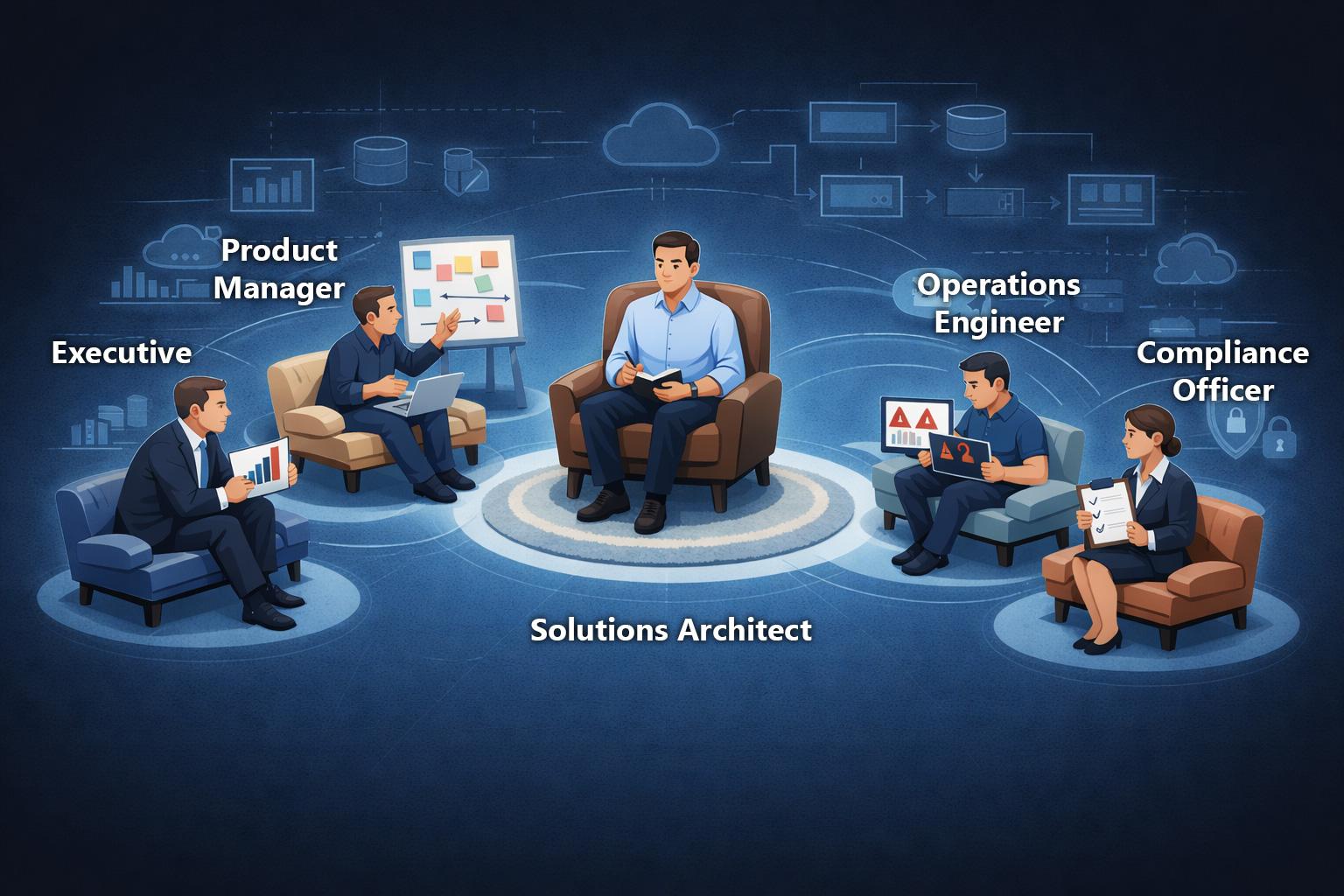
The Solutions Architect role sits in that fascinating intersection where business strategy crashes headfirst into technical reality. Think of it as being the therapist in a room full of people who all have very strong opinions, very different problems, and absolutely no interest in hearing each other out. The executive wants results yesterday. The developer wants to do it properly. The compliance officer wants a signed form in triplicate. Your job is to listen to all of them, figure out what they actually need beneath what they're saying, and guide the group toward a decision everyone can live with, even if nobody is completely happy about it.
Unlike a Software Architect who might spend weeks perfecting a microservices mesh topology, a Solutions Architect is the person who figures out whether your company actually needs microservices or if a well-structured monolith would solve 90% of your problems for 10% of the cost. They're the ones who hear "we want to be like Amazon" and gently explain that Amazon has 1.6 million employees and you have seventeen, so maybe let's start smaller.
The role emerged from a simple truth: beautiful architecture means nothing if it doesn't solve actual business problems, fit within real constraints, and get delivered before the company runs out of money. Solutions Architects are the pragmatists who make technology actually work for organizations.
At its core, the role comes down to five things done well, and done together:
- Bridging business needs and technology: translating what the business is trying to achieve into technical direction, and making sure technical decisions are understood in terms of business impact
- Designing end-to-end solution architectures: producing coherent designs that span the full stack: data, integration, infrastructure, security, and application layers
- Ensuring alignment with the enterprise target architecture: making sure every solution moves in the same direction, rather than accumulating isolated systems that nobody can integrate later
- Safeguarding non-functional requirements: being the consistent voice for security, scalability, reliability, performance, and maintainability, especially when delivery pressure pushes them to the bottom of the backlog
- Guiding delivery teams during implementation: staying involved after the diagram is done, working alongside developers to make sure the built thing actually matches the intended architecture
Remove any one of these and the role starts to break down. Nail all five, and you're the person who makes complex technology programmes actually succeed.
The Many Hats of a Solutions Architect
The Business Bridge
Here's where Solutions Architects earn their therapy metaphor. They sit in meetings where stakeholders say things like "can't we just add blockchain?" or "make it more cloud" and translate these into actual technical requirements. They're the ones who ask the uncomfortable questions: "What problem are we actually solving?" and "What happens if we do nothing?"
They build business cases for technical initiatives, explaining why spending $200K on infrastructure now will save $2M in operational costs over three years. They speak in ROI, time-to-market, and competitive advantage, the language of executives who control the budget. And they translate back: turning technical constraints into business language so that the product manager understands why "just add AI" isn't a sprint story.
| Business Stakeholder Says | Solutions Architect Translates To | Actual Solution |
|---|---|---|
| "We need AI capabilities" | "What decisions are we trying to automate?" | Probably a rules engine with some ML for edge cases |
| "Make it scalable" | "How many users in 1/3/5 years?" | Right-sized infrastructure with growth path |
| "Add real-time features" | "What needs to be real-time vs. near-real-time?" | WebSockets for critical paths, polling for everything else |
| "Improve security" | "Which compliance frameworks and threat models?" | Targeted security controls, not a $500K enterprise suite |
The End-to-End Solution Designer
A Solutions Architect needs deep technical chops. You can't design solutions for problems you don't understand. They need to know the difference between eventual consistency and strong consistency, understand when to use message queues versus REST APIs, and have opinions about database choices that go beyond "I like PostgreSQL because the elephant logo is cute."
But the key word is end-to-end. A solution architecture covers the full stack: data flows, integration patterns, infrastructure choices, security controls, and application design, all in a coherent whole. The dangerous trap is designing only the part you're most comfortable with and leaving the rest vague. Vague architecture gets filled in by developers under time pressure, usually in ways that create pain later.
What end-to-end design covers:
- Application and service architecture
- Data architecture: storage, access patterns, retention, migration
- Integration: APIs, messaging, events, ETL, and the seams between systems that were never meant to talk to each other
- Infrastructure and deployment topology
- Security controls at every layer, not bolted on at the end
- Operational concerns: monitoring, alerting, failure modes
They also need to know when the technically inferior solution is actually the right choice. Sometimes the answer is "use the boring technology your team already knows" rather than "let's rewrite everything in Rust because it's memory-safe." The best technical solution that never ships helps exactly nobody.
The Enterprise Architecture Compass
No solution exists in isolation. Every new system either aligns with where the organization's architecture is heading, or it doesn't, and you spend the next five years paying for that divergence.
Solutions Architects serve as the link between project-level design and the enterprise target architecture. They know which platforms are strategic and which are being retired. They make sure new solutions use approved integration patterns rather than inventing new ones. They flag when a proposed design would create a new silo that contradicts the integration strategy everyone agreed to last year.
This is the discipline that prevents organizations from ending up with forty-seven slightly different ways to do authentication, or three separate customer data stores that have quietly drifted out of sync.
What this looks like in practice:
- Validating designs against architecture principles and standards
- Identifying reuse opportunities before teams build from scratch
- Raising conflicts with technology roadmaps before they become sunk costs
- Participating in architecture review boards with enough context to give useful feedback, not just compliance checkboxes
The Guardian of Non-Functional Requirements
Delivery pressure has a well-known victim: everything that isn't a feature. Security, scalability, reliability, performance, maintainability. These fall off the backlog because they don't show up in demos and don't get celebrated at sprint reviews.
The Solutions Architect is the person who keeps these on the table. Not as a compliance burden, but as real design constraints that shape every significant decision. A system that works under today's load but breaks at 10x is not a scalable system; it's a ticking clock. A solution without a clear security model is a liability waiting to be discovered.
The non-functional requirements that matter most:
- Security: Threat modelling, authentication and authorization design, data classification, compliance requirements (GDPR, HIPAA, ISO 27001, whatever applies)
- Scalability: Load projections, horizontal vs. vertical scaling strategies, bottleneck identification
- Reliability: Availability targets, failure mode analysis, disaster recovery, data durability
- Performance: Latency budgets, throughput requirements, caching strategies
- Maintainability: Operational complexity, runbook requirements, upgrade paths, team cognitive load
The Solutions Architect doesn't need to specify every implementation detail. They need to make sure these questions are answered by someone, on purpose, before go-live.
The Implementation Guide
Good Solutions Architects don't just hand down architecture documents from on high and disappear. They stay involved during delivery. The gap between architecture as designed and architecture as built is where projects quietly fail, and the only way to close that gap is to remain present.
This means working with development teams and understanding their day-to-day constraints and challenges. It means doing architecture reviews mid-sprint, not just at milestones. It means being the person developers bring their implementation questions to. Because if they can't ask, they'll make a call themselves, and it may not be the one you'd make.
They mentor developers, review code when needed, and help teams navigate technical decisions. They're the safety net that catches architectural drift before it hardens into production reality.
The goal is coherence. An architect who is too hands-off will find that the thing that shipped doesn't match what they designed. An architect who is too prescriptive will slow delivery and breed resentment. The right level of involvement is enough to keep the architecture honest without becoming a bottleneck.
Why Your Calendar Is a Disaster
Let's walk through what a typical Tuesday for a Solutions Architect actually looks like:
9:00 AM - Architecture Review
Review a proposed microservices design for the patient portal. Gently suggest that three services might work better than seventeen, and that maybe the "user preference service" doesn't need its own database.
10:30 AM - Vendor Evaluation
Sit through a sales pitch for an "AI-powered cloud-native enterprise solution." Translate the marketing speak into actual capabilities. Realize it's just a REST API with a fancy dashboard. Estimate it would take two developers three weeks to build the parts you actually need.
12:00 PM - Lunch (Theoretically)
Actually spend it diagramming the integration between your new system and the 15-year-old claims processing system that runs on Oracle 9i and communicates via FTP. Yes, FTP. In 2026.
1:00 PM - Stakeholder Meeting
The one from our opening scene. Navigate between competing interests, technical constraints, and budget reality. Propose a phased approach: basic recommendations using collaborative filtering (which you can build), with a path to ML-based personalization in phase two (once you have data and budget).
3:00 PM - Technical Deep Dive
Work with the development team on the authentication flow. Someone suggests rolling their own JWT implementation. Spend 30 minutes explaining why that's a terrible idea and why they should use an established library. Feel old.
4:00 PM - Documentation
Update the solution architecture document. Add the integration patterns you figured out. Create a decision log explaining why you chose PostgreSQL over MongoDB despite the CTO's enthusiasm for "web-scale."
5:00 PM - Compliance Review
Meet with the security team about HIPAA requirements. This is the non-functional requirements conversation that should have happened six weeks ago but didn't. Discover three things you need to change in the architecture: data at rest encryption, audit logging scope, and a consent management flow nobody modelled. Add two to the current sprint and one to the technical debt backlog. Make a note to get into the next project kickoff earlier.
It's a Product, Not a Sum
Here's where most career advice about Solutions Architects goes wrong. They describe the role as a list of skills to acquire: get some cloud certifications, learn to talk to stakeholders, understand agile, become T-shaped. Check the boxes, collect the badges, become an architect.
That's not how it works.
Gregor Hohpe, one of the sharper thinkers on architecture and enterprise transformation, makes a compelling point about architect skill development:
"Becoming an architect is not a matter of addition, but one of force multiplication"
You may have heard of T-shaped professionals, broad knowledge with depth in one area. Some extend this to Pi-shaped, meaning depth in two areas, because the Greek letter π has two legs. The Greek letter Pi stands for product, while Sigma indicates the sum. So rather than describing the shape of your skills profile, think of Pi as describing how your skills interact. The best architects are Pi-shaped: the value they create comes from the product of their skills, not the sum.
Why does this matter? Because multiplication has a property that addition doesn't: a zero in any factor collapses the whole thing. A Solutions Architect who is technically strong but cannot communicate with executives creates solutions that never get funded. One who understands the business perfectly but ignores the operational realities of the team creates beautiful plans that never ship. Each skill amplifies the others, and a significant gap in any dimension doesn't just subtract from your impact, it multiplies against it.
This reframes how you should think about your own development. The question is "which gap is currently limiting the product of everything I already know?"
Technical Breadth as a Multiplier
Solutions Architects need technical depth. You can't design solutions for problems you don't understand. You need enough depth in one or two domains to be credible, and enough breadth across many to evaluate trade-offs intelligently.
You don't need to be the world's best Kubernetes expert. You need to know enough to recognize when Kubernetes is the right answer, understand its operational complexity, and identify when something simpler would suffice, and then communicate that reasoning to people who do have deep Kubernetes expertise.
Technical knowledge becomes a multiplier when combined with judgment. Knowing that PostgreSQL can handle your workload is useful. Knowing when PostgreSQL is the boring, correct choice and when it's a liability that will haunt you at scale, that's what separates architects from engineers.
Core technical knowledge areas:
- Cloud platforms (AWS, Azure, GCP) and their service offerings
- Integration patterns (APIs, messaging, events, ETL)
- Data architecture (relational, NoSQL, data warehousing, streaming)
- Security and compliance frameworks
- DevOps and CI/CD practices
- Performance and scalability patterns
Communication as a Force Multiplier
Here's a concrete example of the multiplication principle: technical expertise combined with strong presentation skills creates impact that neither creates alone. An architect who understands distributed systems deeply but can't explain the trade-offs to a product manager will watch good technical decisions get overridden by business priorities they didn't articulate clearly enough. An excellent communicator with shallow technical knowledge will eventually be exposed when the details matter.
But when those two skills combine? The technical depth gives you something worth saying, and the communication skill ensures it actually changes decisions.
Solutions Architects live and die by their ability to communicate across audiences:
- To executives: Focus on business value, risk mitigation, ROI
- To product managers: Emphasize feasibility, trade-offs, timelines
- To developers: Provide technical details, patterns, rationale
- To operations: Highlight monitoring, maintenance, support requirements
The best Solutions Architects can switch between these modes seamlessly, sometimes in the same meeting. That's not a soft skill. It's a force multiplier.
The Business-Technology Loop
A common misconception is that the relationship between business and technology is one-directional: the business defines strategy, and IT executes. Technology doesn't just respond to business strategy. It enables and shapes it.
The shift from product to service business models, for instance, wasn't purely a business idea waiting for IT to catch up. It became viable because of infrastructure innovations: cloud computing made it economically feasible to deliver software as a service, IoT made it possible to monitor and service physical products remotely. The business model and the technology capability co-evolved.
Solutions Architects who understand this loop don't just implement requirements. They identify where emerging technology capabilities could reshape business models, and where proposed strategies are quietly blocked by technical realities the business hasn't recognized yet. That's a different kind of strategic value.
When designing any solution, consider:
- How will this evolve as the business grows?
- What technical debt are we accepting, and is it worth it?
- Are we building capabilities or just features?
- What does this technology make possible that wasn't possible before, and are we taking advantage of it?
- What are we making easier, and what are we making harder?
Organizational Understanding
People, processes, and ways of working need to support each other to fully utilize new technology capabilities. This sounds obvious, but most architects underestimate how often the limiting factor in a technical transformation is the organizational structure that the architecture either fits or fights.
An elegant microservices design deployed into an organization structured around monolithic teams will either slowly drift back toward a distributed monolith or create coordination overhead that exhausts everyone. Conway's Law is real, and ignoring it is an architectural mistake as serious as choosing the wrong database.
The best Solutions Architects think about organizational design alongside technical design. Which teams need to own which services? How does the proposed architecture affect team autonomy and cognitive load? Are we designing a platform that empowers teams, or a system that creates new dependencies?
Political Savvy
Technology decisions are political. Choosing a new platform might threaten someone's empire. Proposing a rewrite might challenge someone's legacy. Solutions Architects need to navigate these waters, building coalitions, managing stakeholders, and knowing when to push and when to compromise.
The architect's position is sitting at "the intersection of just about everything: strategy and execution, governance and innovation, transformation and stability." That intersection is not a comfortable place. Every decision involves navigating tensions between people who care deeply about competing priorities.
This is where political savvy becomes another multiplier. Technical credibility gets you in the room. Communication skill gets your ideas heard. Political awareness determines whether those ideas survive contact with organizational reality.
The Challenges Nobody Warns You About
The Curse of Context Switching
You'll jump from a deep technical discussion about database sharding to a budget meeting to a vendor negotiation, all before lunch. Your brain will feel like it's running too many browser tabs. Time blocking and ruthless calendar management become survival skills.
The Loneliness of Architectural Decisions
Sometimes you'll make decisions that upset everyone: too conservative for the developers who want to try new tech, too risky for the operations team, too expensive for finance, too slow for product. You'll need thick skin and confidence in your reasoning.
The Moving Target Problem
You'll design a perfect solution for the requirements you have today, and tomorrow the business will pivot, regulations will change, or a competitor will launch something that makes your approach obsolete. Flexibility and adaptability are survival traits.
The Credit Paradox
When things go well, the development team gets credit for shipping. When things go badly, the architecture gets blamed. You'll need to find satisfaction in the work itself rather than external recognition.
The Therapist Your Architecture Deserves
So why the therapy metaphor? Because Solutions Architects do for systems what therapists do for people: they listen to everyone's concerns, identify underlying issues that aren't being articulated, help navigate conflicting needs, and guide toward healthier patterns.
They sit with the discomfort of trade-offs. They validate concerns while challenging assumptions. They help organizations make decisions they can live with, even when perfect solutions don't exist. They prevent small problems from becoming existential crises.
The best Solutions Architects understand that their job is to design the right system for this organization, at this time, with these constraints. They balance technical excellence with business pragmatism. They build bridges between what's possible and what's practical.
And here's the key insight for growing into this role: stop treating your skills as a checklist to complete and start treating them as factors in a multiplication. A zero anywhere collapses everything. A strength in one area amplifies every other area. The question to keep asking is "which gap is holding the product down?"
That shift in thinking, from accumulating skills to synthesizing them, is what separates architects who have impressive credentials from architects who actually change organizations.
Share this article
Related articles

Data Mesh: Decentralization Without the Anarchy
Inside a single telco, "Service" means four different things across four different teams. This is the problem data mesh was built to solve and why getting the canonical model right matters more than any platform decision.

Architecture Tradeoff Analysis: Picking Your Poison (Carefully)
Most architecture debates are not about the wrong answer. They are about tradeoffs nobody made explicit. ATAM is the method that forces both pans of the scale to be loaded before anyone decides.

Internal Developer Platforms: Stop Reinventing Wheels in Every Squad
Every squad reinventing the same deployment pipelines, logging stacks, and secrets management. Sound familiar? Here is how Internal Developer Platforms end the cycle and let your engineers focus on what actually matters.
Enjoyed this article?
Subscribe to get more insights delivered to your inbox monthly
Subscribe to Newsletter