The Architect View-Master: Architecture for Every Stakeholder
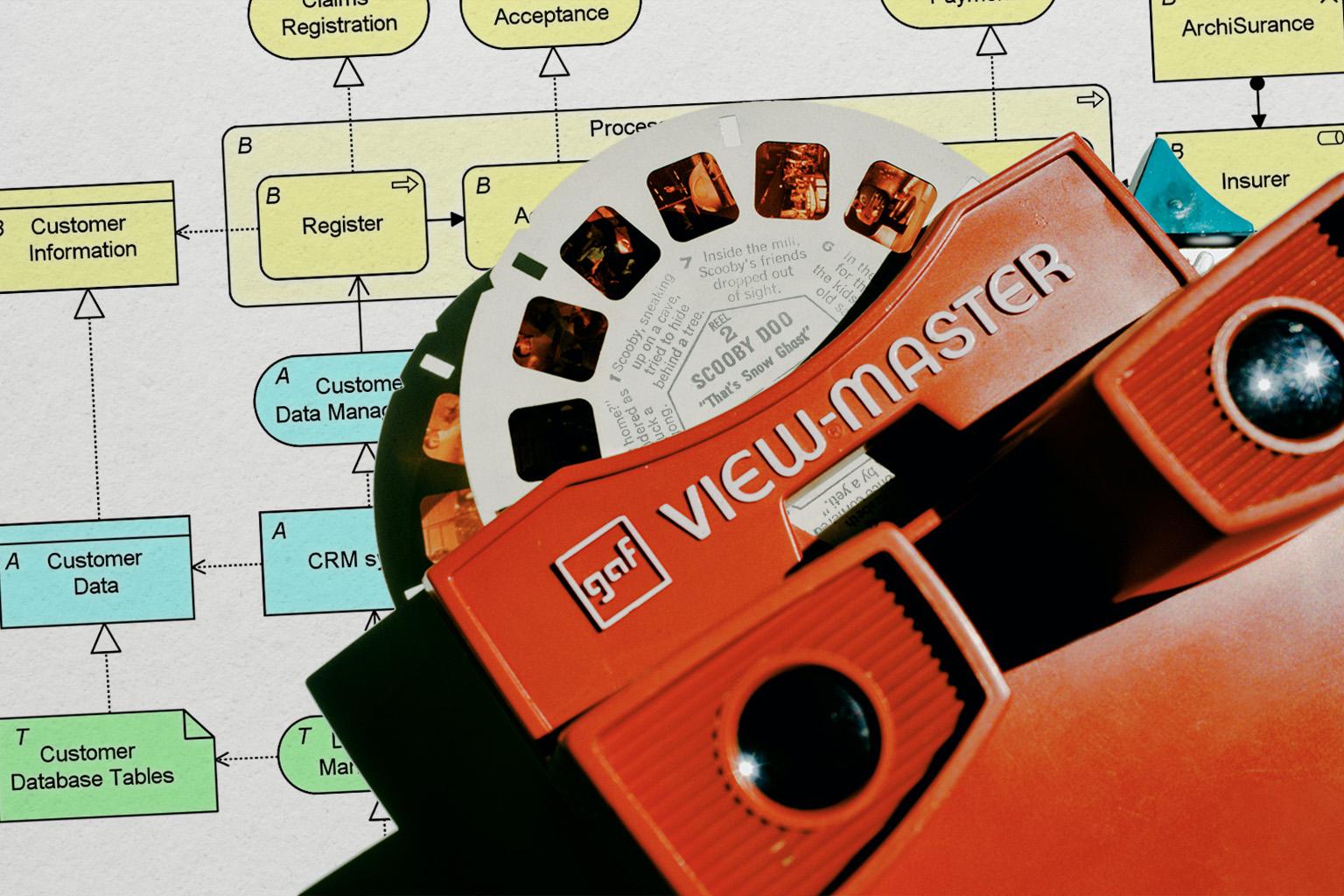
Imagine you’re a kid again, holding a red plastic View-Master in your hands. You pop in a reel, click the lever, and like magic, a new scene appears. Each click gives you a different perspective: Scooby Doo, dinosaurs, the Grand Canyon, space adventures. The magic lies not in the toy itself, but in how it delivers views tailored to your curiosity.
As solution architects, we take pride in delivering structure, clarity, and momentum to complex digital transformations. We chart system landscapes, decouple monoliths, define service boundaries, and make architecture actionable.
But here’s the tension. We often start with the views we want to see: how this API integrates, where this container runs, and what the network boundaries are. These views give us control but can leave critical stakeholders wondering how it all connects to their world. When the program manager asks how your architecture shortens time-to-market, or the business sponsor asks how it maps to strategic outcomes, technical views alone fall short. The problem isn’t a lack of modeling. It’s a lack of perspective.
What Are Views and Viewpoints?
As solution architects, we’re expected to bring clarity to chaos, connecting business goals to technology realities. But how we see the architecture landscape shapes what we design, what we prioritize, and ultimately what we deliver.
Imagine holding a device that lets you switch between scenes. Insert the business stakeholder group reel. Click: you see the business functions. Click again: you see how business services evolve. Another click: how the business process impacts customer journeys or reduces risk. Each frame is clean, purposeful, and reveals just the slice that matters in that moment.
That’s exactly what views and viewpoints offer in architecture.
- Viewpoint: Think of this as the reel you insert. It’s a specification that defines how to construct a view: what concerns to address, what models to use, and what techniques to apply. It’s standardized, and reusable across similar stakeholder groups.
- View: This is the image that pops up when the lever is clicked. A realization of a viewpoint for a specific system or context. It’s what the stakeholder actually sees.
The matrix below provides a helpful example taxonomy to structure your thinking about views. It classifies architectural views across domains and audience groups, creating a grid to guide your selection.
Each cell represents a different kind of view, shaped by both the architectural domain (enterprise, systems, information, technology) and the level of abstraction or role it serves (planner, database designer, user, business manager). By using this matrix, solution architects can systematically align views to stakeholders, ensuring relevance, traceability, and clarity throughout the architecture lifecycle.
Architectural Empathy for What Stakeholders Need
In practice, solution architects are under pressure to deliver quickly. It’s easy to fall into patterns: spinning up the same system context view, the same deployment diagram. These are important but they’re not always the views that unlock decisions or drive alignment. To architect with impact, we need to adjust our view based on who’s on the other side of the table.
1. Map Stakeholders to Concerns
Use a concern-driven approach. What’s keeping this stakeholder up at night? Is it a regulatory risk? Operational cost? Customer satisfaction? Time-to-market? Business continuity?
2. Select Viewpoints with Purpose
Let concerns dictate your architectural lens. Let’s take two examples:
The first example Goal Realization Viewpoint links strategic objectives to architecture components. Great for business sponsors such as the Chief Marketing Officer (CMO) and Chief Executive Officer (CEO). The Strategic Goals to Capabilities View shows how high-level goals are realized through specific business or IT capabilities.
The second example Software System Composition Viewpoint illustrates how a software system fits into its environment and how its internal containers deliver functionality. Ideal for solution architects, product owners, and senior technical stakeholders.
The C4 Model System Context View shows external actors, systems, and integrations, helping align business and IT around scope, interfaces, and dependencies.
The C4 Model Container View breaks the system into deployable and logically distinct parts (applications, databases, services) revealing how responsibilities are distributed and how they collaborate.
3. Balance Technical Depth with Strategic Altitude
Don’t just zoom in, zoom out. Show how your architecture supports business capabilities, risk reduction, or operational agility. Speak their language through your view.
4. Model Once, View Many
Use modeling tools that let you reuse the same underlying architecture data across multiple views, ensuring consistency while tailoring content for different stakeholders. Tools like Archi, Bizzdesign, Sparx Enterprise Architect, LeanIX, and Structurizr support multi-view modeling.
5. Keep Views Lean and Story-Driven
Views aren’t documentation, they’re communication tools. A cluttered diagram filled with every component and relationship is noise. A precise view that answers a stakeholder’s key question? That’s an architecture that moves programs forward.
Perspective is the Architect’s Power
As solution architects, we hold the View-Master. Clicking through frames to understand the enterprise from multiple angles. The real impact does not come from the views we prefer, but from the ones that reveal what matters to others. Each viewpoint is a new reel: strategy, capability, risk, operations. Every view we create is a chance to make the architecture clearer, more actionable, and more aligned. Don’t settle for your default lens. Switch reels. Shift frames. Because the value of architecture lies not in what we build, but in what others can see through it.
Share this article
Related articles

Data Mesh: Decentralization Without the Anarchy
Inside a single telco, "Service" means four different things across four different teams. This is the problem data mesh was built to solve and why getting the canonical model right matters more than any platform decision.

Architecture Tradeoff Analysis: Picking Your Poison (Carefully)
Most architecture debates are not about the wrong answer. They are about tradeoffs nobody made explicit. ATAM is the method that forces both pans of the scale to be loaded before anyone decides.

Internal Developer Platforms: Stop Reinventing Wheels in Every Squad
Every squad reinventing the same deployment pipelines, logging stacks, and secrets management. Sound familiar? Here is how Internal Developer Platforms end the cycle and let your engineers focus on what actually matters.
Enjoyed this article?
Subscribe to get more insights delivered to your inbox monthly
Subscribe to Newsletter